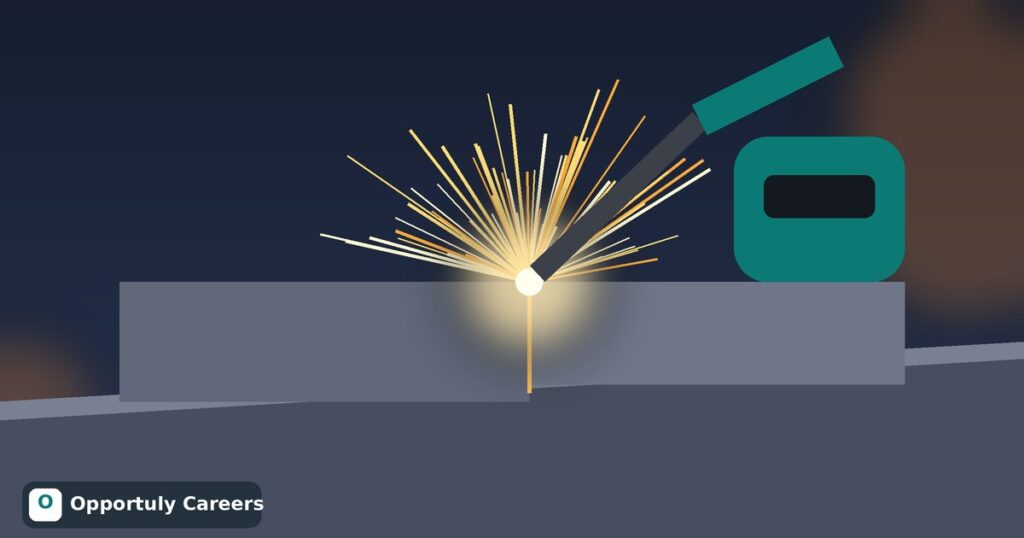
Welding is a hands-on trade that is needed in construction, shipbuilding, manufacturing, energy, vehicle repair and maintenance. Employers rarely care where you learned the skill as much as whether you can produce a sound weld that passes inspection. That is why the career is built around practical tests and qualifications that prove what you can do.
This guide covers the main welding processes, how qualification works in different regions, the health and safety points that every welder must know, and a step-by-step route to your first job. We do not list vacancies or quote wages; we link to official sources so you can check current conditions where you live.
What welders do
Welders join metal parts using heat, and sometimes pressure and filler material. Depending on the job, the work can include:
- Reading drawings and welding symbols, and following a welding procedure specification (WPS).
- Preparing joints by cutting, grinding and cleaning metal.
- Setting up equipment: current, wire speed, shielding gas and electrodes.
- Welding in different positions, from flat bench work to overhead or vertical welds on site.
- Inspecting welds visually and fixing defects; on critical jobs, welds are also tested by inspectors.
- Keeping the workspace safe from fire and fumes.
The main processes
- MIG/MAG (GMAW): a continuous wire with shielding gas; common in fabrication and production.
- TIG (GTAW): precise, clean welds on thin metal, stainless steel and aluminium.
- Stick (SMAW / MMA): flexible and widely used on site and in repair work.
- Flux-cored (FCAW): high deposition rates, often used outdoors and in heavy fabrication.
Many welders start with one or two processes and add others as their career progresses.
How welder qualification works
Certification tests
Most employers ask for proof that you have passed a test for a specific process, material, thickness and position. In the US, the American Welding Society certification programs are widely recognised. In Europe and many other countries, welders are qualified to the international standard ISO 9606 (for example, ISO 9606-1 for steels), usually through an accredited test centre or the employer’s examiner. Qualifications must be kept valid through regular work or retesting, so keep your records up to date.
Training routes
You can learn through vocational schools, apprenticeships, adult courses run by public employment services, or on the job. In the US, the O*NET profile for welders, cutters, solderers and brazers summarises the tasks, skills and typical education. In England, the National Careers Service welder profile describes college courses and apprenticeships.
Health and safety you cannot skip
Welding involves real hazards: fumes and gases, ultraviolet radiation, burns, electric shock, fire and noise. The OSHA welding, cutting and brazing page and the UK HSE welding guidance explain the controls employers must use, such as local exhaust ventilation, respiratory protection, eye and skin protection and hot-work permits. A good employer will train you on these controls and provide the equipment; ask about it in the interview.
Where welders work
- Fabrication shops: structural steel, frames, tanks and machinery, usually on day or shift work.
- Construction and civil engineering: bridges, buildings and site work, often outdoors.
- Manufacturing lines: repetitive production welding, sometimes alongside welding robots.
- Maintenance and repair: factories, farms, mines and transport fleets.
- Energy and marine: pipelines, shipyards and offshore platforms, typically with extra certifications and rotations.
Skills employers look for
- Steady hands, good eyesight and the patience to repeat high-quality work.
- Ability to read technical drawings and measure accurately.
- Knowledge of metals and how they react to heat.
- Physical stamina for working in awkward positions and sometimes at height.
- A safety-first attitude and the discipline to follow procedures.
Pay and conditions: how to check
Pay varies with process, certifications, sector and location; offshore, pipeline and specialised work usually involve travel and rotations. Before accepting, ask for written details of the hourly rate, overtime, shift pattern, who pays for testing and protective equipment, and whether travel time is paid. Use official statistics such as O*NET (US) or your national statistics office for wage ranges rather than figures in adverts.
How to apply, step by step
- Pick a starting process. MAG and stick are common entry points; TIG is in demand for stainless steel and precision work.
- Get trained and practise. Choose an accredited course or apprenticeship, and log your practice hours.
- Pass a qualification test. Make sure the certificate states the process, material, thickness and positions.
- Build a simple portfolio. Photos of your test coupons and projects, plus copies of certificates, make a strong impression.
- Apply directly to fabricators and contractors. Use public job portals and company career pages; many employers will ask you to complete a practical weld test.
Official page of the American Welding Society. In Europe, ask an accredited test centre about ISO 9606.
Frequently asked questions
Do I need a degree to become a welder?
No. Most welders qualify through vocational training, apprenticeships or practical courses, followed by a welding test.
Which process should I learn first?
MAG or stick welding are good foundations. Once you are confident, TIG opens doors to precision and stainless steel work.
Do welding certificates expire?
Many do, unless you keep welding in that process or retest. Check the rules of the scheme that issued your certificate.
Is welding dangerous?
It can be if controls are missing. With proper ventilation, protective equipment and training, the risks can be managed.
Sources
- American Welding Society – Certification
- O*NET OnLine – 51-4121.00
- National Careers Service – Welder
- OSHA – Welding, Cutting, and Brazing
- HSE – Welding
More job guides
- Truck Driver Jobs: Licences, Training and How to Get Hired Safely
- Security Guard Jobs: Licences, Training and How to Apply
- Hotel Housekeeping Jobs: What Room Attendants Do and How to Get Hired
- Supermarket Cashier Jobs: Duties, Skills and How to Apply
- Waiter and Waitress Jobs: What the Work Involves and How to Get Hired
- Remote Customer Service Jobs: How They Work and How to Spot Real Offers
- Machine Operator Jobs: Tasks, Safety Rules and How to Get Started
Opportuly Careers is an independent guide. We do not recruit, we do not represent any employer and we never charge for information.